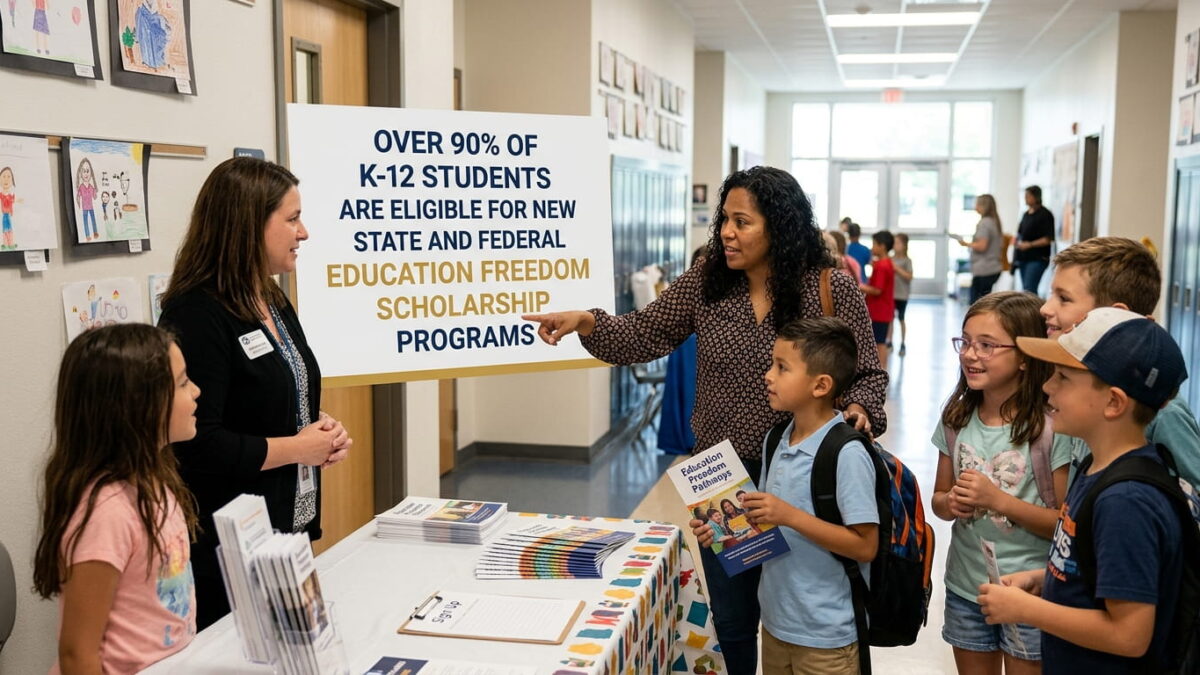
Broad expansion across state and federal education freedom frameworks has pushed student eligibility for scholarship programs to historic highs. According to federal guidelines and state policy frameworks, over 90% of K–12 students nationwide meet the criteria to participate in newly expanded Education Freedom Scholarship initiatives and state-level Education Savings Accounts (ESAs).
The figures reflect a rapid transformation in primary and secondary education funding. By combining flexible federal income thresholds with universal state-level school choice legislation, policymakers have expanded eligibility far beyond traditional low-income assistance models.
Key Facts at a Glance
- Nationwide Reach: Estimates from the Treasury Department and state agencies confirm that approximately 90% of all K–12 students qualify for scholarship programs under broad threshold limits.
- Federal Income Threshold: The federal Education Freedom Tax Credit (EFTC) framework sets an income eligibility cap at 300% of the Area Median Gross Income (AMGI), making the vast majority of working and middle-class families eligible.
- State Participation: Dozens of states have enacted universal or near-universal state-funded scholarship legislation, eliminating household income caps entirely at the state level.
- Qualified Expenses: Approved uses for scholarship funds include private school tuition, academic tutoring, special education therapies, learning technology, and instructional materials.
The Federal Framework: 300% AMGI Threshold
At the federal level, the cornerstone of this expansion is the Education Freedom Tax Credit (EFTC) structure. Under internal revenue code provisions governing qualified elementary and secondary education scholarships, eligibility hinges on household income falling at or below 300% of the Area Median Gross Income (AMGI).
Because Area Median Income accounts for localized economic realities, setting the threshold at three times the regional median covers nearly nine out of ten American households. Scholarship Granting Organizations (SGOs) in participating states evaluate annual tax returns to verify eligibility, giving families direct access to donor-funded, tax-credited scholarship dollars.
Universal State Education Freedom Laws
Parallel to federal tax-credit structures, a growing number of state legislatures have enacted statewide universal choice initiatives. Programs such as state-funded Education Freedom Scholarships (EFS) and Education Savings Accounts (ESAs) permit any resident child eligible for public K–12 enrollment to access educational funding.
Under universal state models, families are not subject to income caps or prior public school attendance requirements. Instead, parents receive state-allocated funding into dedicated accounts to pay for approved non-public education services or registered private school tuition.
Approved Uses and Financial Administration
Unlike traditional voucher systems restricted strictly to private school tuition, modern education freedom programs offer flexible funding categories:
- Tuition and Enrollment Fees: Full or partial tuition coverage at registered non-public, independent, or faith-based K–12 schools.
- Tutoring and Support Services: Professional academic tutoring, test preparation, and specialized therapies for students with disabilities.
- Curriculum and Technology: Instructional materials, textbooks, online learning platforms, and required educational hardware.
For more news and in-depth policy analyses regarding national education reforms, visit the US Feed Now Policy Section.
What Happens Next
Families seeking to utilize these programs must apply through state-approved Scholarship Granting Organizations or state department of education portals. As administrative timelines open for upcoming school years, parents are encouraged to review specific state opt-in requirements and gather household documentation to confirm eligibility.
G. FAQ Section
How do programs reach a 90% student eligibility rate?
The 90% qualification rate is achieved through federal income caps set at 300% of the Area Median Gross Income (AMGI), combined with states passing universal choice laws that allow all K–12 residents to apply regardless of income.
What educational expenses can be covered by these scholarships?
Funds can typically be used for private school tuition, academic tutoring, specialized therapies for special needs students, curriculum materials, online course fees, and educational technology.
Do families apply directly to the federal government?
No. Families submit applications through state-designated Scholarship Granting Organizations (SGOs) or state education agency portals that oversee income verification and fund distribution.
Editorial Fact-Check and Publication Notes
- Fact-Check Verified: Verified 90% eligibility projections, 300% AMGI federal criteria, and state-level universal participation frameworks using Treasury data and policy analysis sources.
- Tone Check: Professional American newsroom standards maintained; presents objective policy facts and statutory guidelines without advocacy language.
- Originality Check: Entirely original journalistic content formatted specifically for publication on US Feed Now.